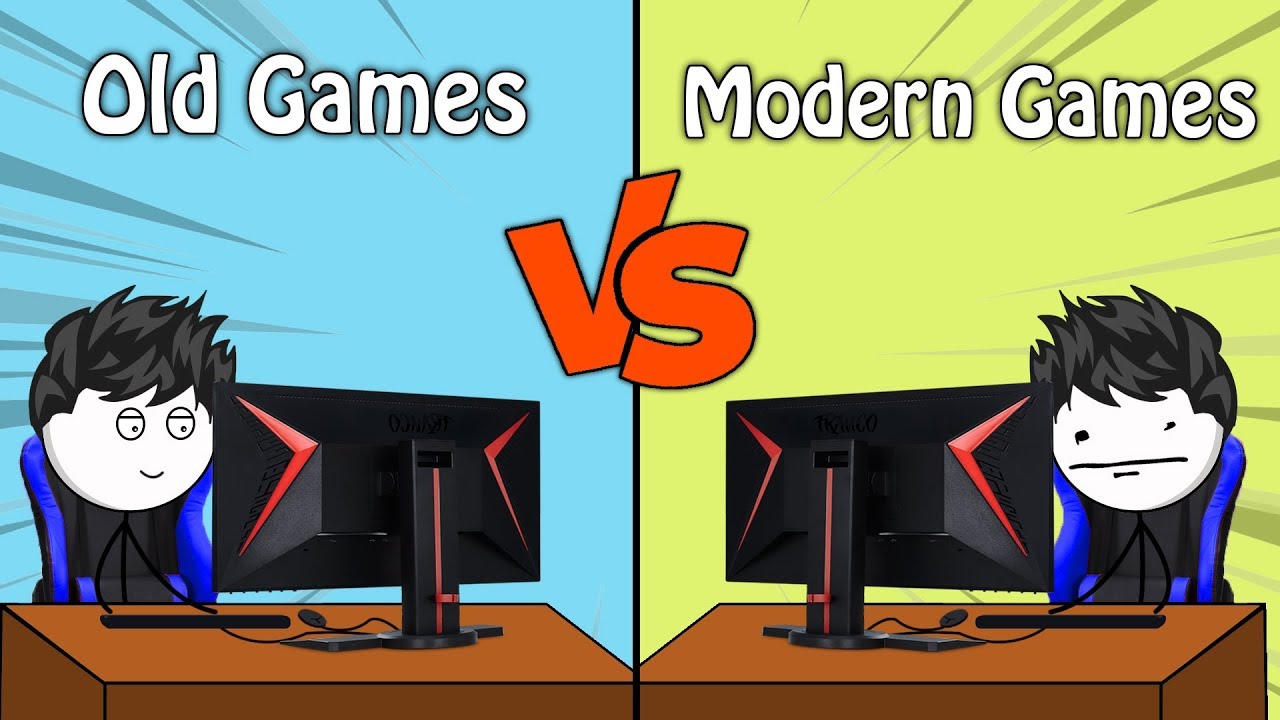
Many people tend to believe that old games were much more difficult compared to modern ones. As much as this point of view is not completely groundless, as older games had certain peculiarities modern games do not. Fundamentally however it is incorrect to merely label older games as plain harder.
To explain what I mean I have to outline the fundamental differences in how games were designed back then compared to now.
Nowadays videogames are an established multibillion industry with lots of developers and experience. They know how games are made and can deliberately aim for a certain particular experience. Most of the time they aim to make game as accessible as possible to increase its reach and appeal to maximum possible players. To that end they make games as easy as possible so that even the dumbest of players could play them.
That however resulted in a certain backlash from veteran players who claimed that games are getting too easy and dumb. The industry responded by making hard games, targeted at this veteran demographic. Demon Souls pioneered this idea and ever since they are called soulslike.
However, what soulslike does is just inverts the above-mentioned accessible trend, by deliberately cranking up difficulty level in order to imitate old games, that satisfies some veterans but not all of them. Some, and I am one of them, still feel it's not hitting the mark and does not replicate all what old games used to be.
A while back I wrote an article on how older games were smarter, not harder. They appealed towards more intelligent people with their more sophisticated plot and mechanics. While this in itself is correct, that only covers certain games. Many of these games are my favorites but what about others? What they had that modern games lack ... or, perhaps the other way around, what old games lacked that modern have?
Back to the statement in my opening paragraph on modern games, I said that modern mature industry has plenty of experience to make games exactly as they intend to. Back in the days the industry lacked this experience. To put it simply they had little to no idea what were they doing. It's this lack of expertise and understanding what they were doing that produced some of the most acclaimed and beloved games out there.
That sounds contradictory, how could someone who has no idea what they are doing somehow beat years of experience, research and budget? Yet game industry experience showed us just that. Sure, it was hit and miss, some games flopped miserable, but others were rocketed to stardom of modern classics.
If you think about it, it was the same in other industries and art forms too. Renaissance authors and artist produced many acclaimed art pieces. Modern artists can imitate them perfectly but no matter what they produce it will never be as acclaimed as famous Mona Lisa.
However, is originality all there is to it? There is nothing more than just being first, the original author status? I would argue not.
This lack of understanding what were they doing led towards games that were somewhat uneven in their experience. Creators had no idea how to deliberately tailor game to be easier or harder. It resulted in some parts being easy and others harder. The latter part being noticed a lot more often than the former because it sometimes led towards lengthy discussions and strategy guides on how to beat it, but the former should not be underestimated either.
Overall however games had average difficulty, things balanced out, games certainly provided certain challenge to a player, but it was not ball crushingly difficult, it was manageable, playable. Blizzard, who made many acclaimed games during that era, used to emphasize balance among other things, balance between difficulty and playability. Modern games thrown this balance out of the window completely, they go for extremes instead, either so hard, it's basically unplayable, or so easy the game basically plays itself, making player redundant.
Because of sudden difficulty spikes, developers had to give players means to survive rough edges and try again. Otherwise, game will not be playable. Long health bars, healing potions, various power ups that gradually became game staples, originally were all means developers had to add to the game to help player beat it. Often overlooked or reduced in importance and scope nowadays, these were more important than people like to believe. Diablo 1 and 2 would not be playable if you could not just fill inventory with potions to beat harder bosses like Butcher, Duriel and Diablo himself. Yet modern souls like developers think they can make bosses even more menacing without giving players ability to heal and call it old school. Its anything but. Even Diablo Immortal makes this mistake with Hellquary bosses.
Furthermore, health bars and potions allowed players to not only make mistakes and survive but also learn from these mistakes and try again. That in turn made older games not just plain hard or easy, but games of knowledge effort and skill instead. Faced with feedback loop of losing health if you play badly and keeping it if you do better, led towards players gradually learning to play better and better.
The fact that it was skill based even led towards creation of esports where other players watch how best of them play against each other, StarCraft II is good example. Even in worst case scenario where there was only memorisation of patterns and where various things are, with hardly any skill involved, it still led towards players developing at least memory if not the skill.
That is something that completely missing from modern games where either you kill everything in one hit, or some random shit kills you in one hit. Faced with instant death from something you cannot even see coming, you cannot learn anything or use your skills to mitigate or avoid danger. It makes skill useless and that is what angers veterans most. In the past you could always win by playing better, nowadays not so much. There are so much you can add to abilities of various bosses, until it becomes nigh impossible to just outsmart them like it was possible back then.
But there is more, this lack of understanding produced games that were much more diverse that modern tailored ones. When developers did not know what works and what doesn't, they kept experimenting with various stuff. It was hit and miss, but that made playing new games akin to a discovery journey. Like exploring Americas or space.
New games came with new weapons, abilities, design features and more. Not all of them worked well and some features developers spent effort creating ended up not being used by players. However, those that stroke cord with players made their creators instant legends, like bullet time in Max Payne.
Nowadays developers are far too conservative to experiment with new things out of fear of wasting the budget on a flop. That made games all too predictable as not matter how much environment changes, mechanics are all the same all the time. No new trick or skill was ever created since couple of decades ago.
Since developers themselves often had no idea how to play their own games, it came up to players to develop their own strategies using skills and abilities developers placed in game. Example of this are many different builds that Diablo II has for example. There are no just one or two ways to play the same characters, many skills allow for many variations. And players keep inventing more and more.
Yes, something like that leaves risk of new player fucking it up completely by picking skills that do not work well together or at all, but that is a price to pay for flexibility. If anything, it is much better if game would allow players to change their skills to allow them to experiment, try new things and ideas and see how it goes. That will allow players to feel certain level of accomplishment by figuring out the way to use the skills better and beat the game more skillfully. It's much like in real life sport were figuring out ways of doing things better allows one to win over other teams.
Final thing is a sense of accomplishment. When game is not so much designed as a cohesive experience so much as the world for a player to live in and explore, it allows player to feel sense of accomplishment in achieving something in game. When you find something rare, cool or unique you feel like you achieved something with your own efforts. You feel like your efforts or skills or dedication produced these rewards for you, that you own them. Rarity of the achievement makes you feel special, either uniquely skilled or uniquely lucky. In contrast if all the game has is easily obtainable by every player, then you do not feel special, you are faced with reality that you are just like everyone else.
Sure, in the end of the day developers placed all the items in the game, but at least illusion of finding something on your own or figuring out how to beat a tricky boss gives you sense of self-worth and pride in one's skill and dedication. And mind you real skill and dedication was involved; thus, sense of accomplishment is not entirely hollow.
One of the most important aspects that games can uniquely provide, that real life cannot is sense that you are special and important, that you are better than everyone else. It's tricky to achieve but games that succeed in it, end up being beloved classics, often in spite of many flaws they may otherwise have. Europa Universalis and Legacy of Kain series are good examples of that. Yet games that seamlessly have it all but fail to give you feeling of being special someone fundamentally fail to strike chord with the gaming crowd.
I would even say that people like 'hard games' not because they enjoy hardships, but rather because they want to feel sense of accomplishment from beating something that is considered hard and then be proud about themselves for that fact. It's not as much as its hard, as much as its considered important in the game's world. That doing it means you saved the world and everyone is grateful to you for that.
I will conclude with a little allegory. Old games were like exploring America, you did not know what will await you, but you feel excited to find and try something new and cool. And maybe, at the end of it all, you will be celebrated like Columbus, Pizarro or Magellan. Back in the days games themselves were new and groundbreaking, playing them was like exploring uncharted lands and experiencing never before seen things.
New games are like amusement park ride, it's fun safe accessible and predictable, but no one ever got themselves a monument on the city square or mentioning in history book for riding a rollercoaster.
Old games maybe were on average harder than most modern ones, but they were not designed to be so and are certainly loved for different reasons. Thus, it's pointless to try to appeal to veteran games by making games as hard as possible.
While recreating this sense of novelty is probably impossible, modern games would do well to at least recreate those aspects that could be re-created, such as rewarding skills and experimentation instead of just railroading experience. In general, they should stop aiming for extremes and instead aim for a balanced experience, moderately challenging but enriching overall.


No comments:
Post a Comment